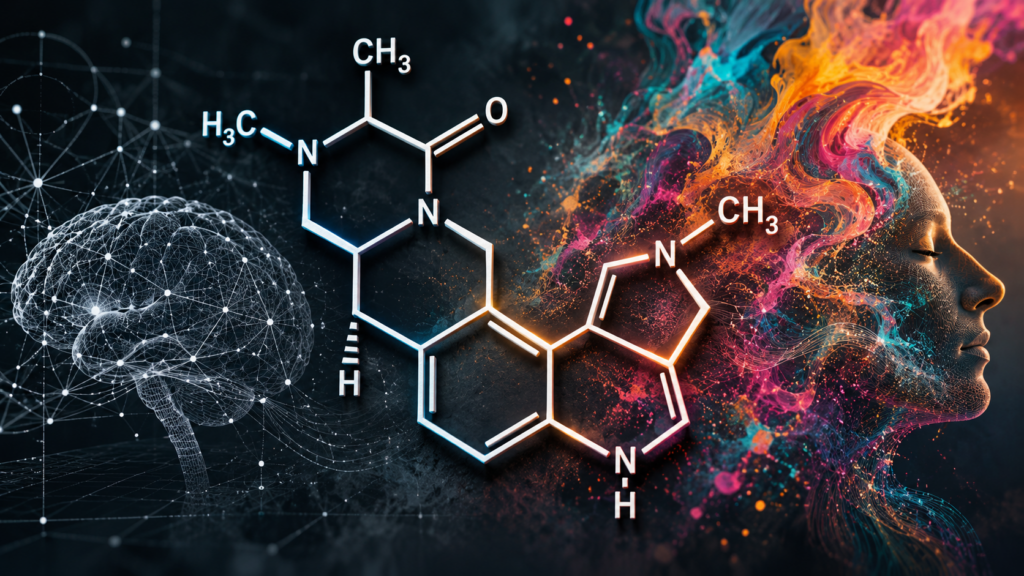
The marketing around psychedelics is relentless. So I decided to test it myself.
This is Part 1 of my three-part series on psychedelics as the savior of modern performance.
If you’ve been anywhere online or in entrepreneurial circles in the last few years, you’ve heard the pitch.
Psychedelics are going to unlock your productivity, accelerate your results, give you easier access to flow states, and make the grind of building a business feel almost effortless.
Ayahuasca will help you face the fears running your life. Psilocybin journeys will dissolve the limiting beliefs holding you back. MDMA will rebuild the intimacy and trust your marriage lost. Plant medicine retreats overseas will give you the breakthrough you’ve been chasing.
The market is selling psychedelics as the cheat code.
And a lot of successful people I know are buying it.
The Promise Of Full-Dose Experiences
The full-dose journey is where the boldest claims live.
You go to a retreat, work with a facilitator, drink the brew or take the dose, and surrender to the experience for hours of intense altered consciousness. Visions, emotional releases, ego dissolution, reconnection with something larger than yourself.
The promise is transformation. Permanent change. Years of therapy compressed into a single weekend. A new relationship with your patterns, your fears, your wounds, and your purpose.
The testimonials are everywhere. Tech founders crediting ayahuasca for personal transformation. Hedge fund managers talking about how a psilocybin journey reset their priorities. CEOs sharing emotional posts about the marriage they saved, the trauma they processed, the version of themselves they finally became after one weekend at a retreat in Costa Rica.
The conversations are happening at high-end masterminds, in private groups, in hushed locker room talks after yoga class, and in DMs between successful people who’d never publicly admit they’re doing this. The stigma is gone and the curiosity is intense. The marketing is sophisticated and the success stories keep multiplying.
For someone evaluating whether this might be the missing piece in their own optimization journey, the counter-narrative is hard to find.
I have been in those rooms, I have received those DM’s.
Let me tell you about someone I know and have been observing for two years
What I’ve Watched Happen
I met Sarah at a mastermind event two years ago and we’ve stayed connected, both professionally and socially ever since.
Sarah is a driven entrepreneur who cares deeply about her family. I admire her business sense and appreciate when she shares insights in masterminds.
And she’s been through a lot over the last couple of years.
She left her husband recently. She’s questioning her career. And she’ll tell you, with real conviction, that the psychedelic work has been transformative. She feels empowered in her decisions. It’s easier for her to be around her happily married friends without spiraling. She moves through hard moments with more grace than she used to.
She’s done the full spectrum of psychedelics – psilocybin journeys, plant medicine ceremonies, regular microdosing protocols.
When she opens up about her life and I listen to her story, I see the same patterns in her that I see with a portion of my clients;
- unworthiness running underneath every decision.
- unresolved feelings toward a parent
- Unhelpful patterns repeating in different forms.
For Sarah, the psychedelics are helping her cope with the symptoms of these wounds. They’re not healing the wounds themselves.
My concern for Sarah (and other people like Sarah) is that she is going to keep needing more journeys, more substances, because the root cause is still untouched. Until someone does the deeper work with her on those original wounds, she’ll keep cycling through interventions wondering why the breakthroughs don’t fully stick.
What Sarah needs is someone trained in modalities like Time Line Therapy, Neuro-Linguistic Programming (NLP), and Hypnosis. Approaches designed to access the unconscious mind and resolve the original wounds at their source. That’s the work most coaches can’t do. (I’ll cover why that matters in Part 3.)
So Why Did I Do It Anyway?
After watching Sarah’s pattern for two years, you might assume I would have ruled out psychedelics completely. That I focused on the inner work and skipped the substances.
I didn’t. But I went a different direction than Sarah.
Full-dose experiences weren’t the right fit for what I was trying to accomplish. I didn’t need a transformational weekend or an ego death. What caught my attention was microdosing, a completely different approach that wasn’t about altered states at all.
Microdosing has its own specific promise. You take a sub-perceptual dose of LSD or psilocybin a few times a week. No trippy visuals. No psychedelic experience. Just enhanced cognition without the side effects of stimulants.
The pitch is sharper focus, better creative output, and more flow during deep work.
For high-output entrepreneurs and professionals, this sounds like the answer. A small intervention, twice a week, that gives you more output without more effort.
I’m someone who tests everything on myself before I ever consider it for clients. Peptides, supplements, training protocols, hormone optimization, advanced testing methods. I’ve been the first test case for every intervention I’ve ever explored.
If there was even a fraction of truth to what the market was promising about microdosing, I wanted to know. Not from anecdotal evidence on a podcast or some scientific study, but from my own experience.
So I made a decision:
I’d run a controlled experiment on myself, track what changed, and be honest about what worked and what didn’t.
And that’s how I ended up standing in my bathroom at 6:30 AM on a chilly Thursday morning in early March holding a dropper.
That Chilly March Morning
I’d done my homework over several months: reading the preliminary research papers, talking to half a dozen people running their own protocols, and connecting with a certified psychedelic educator who would guide me through my own protocol.
There I was standing in my ensuite bathroom, staring at the bottle in my hand in the brightly lit mirror the bottle in my hand. But I was nervous.
I grew up in the 80s, right at the peak of the anti-drug movement. That was the mentality of everyone around me. My parents, my teachers, and sports coaches. “Just say no” wasn’t a slogan, it was the lens through which every authority figure I knew interpreted the world.
I never tried anything in high school or college. Even my first experience with CBD oil for my back pain in my late 30’s came through a medical prescription from a doctor, not from a friend or street corner dealer.
So standing in my bathroom at 6:30 in the morning, holding a dropper bottle of LSD, was completely outside of anything I’d ever done.
I went into the bathroom on purpose. I wanted to look in the mirror. I wanted to see myself, count the drops carefully, and not accidentally take too much. Was it going to be a slow drip or would they come out in a rush? Could I miscount?
The protocol called for four drops. I needed to land exactly on four.
I held the bottle steady. I looked at myself in the mirror. Took a slow breath.
And then I took my first dose.
What happened next is what I’ll cover in Part 2.
Cheers,
Deepak