
Most Leaders Either Ignore Peptides Or Waste Money On Garbage. Both are Expensive Mistakes
Most founders and executives running companies fall into one of two camps when it comes to peptides:
Camp 1: They either haven’t heard of peptides or they’ve written them off as unproven biohacker hype.
Camp 2: They dive in headfirst after hearing about them on a podcast or Instagram reel, buy some inferior product online from a source they can’t verify, follow a protocol they found in a forum… and feel nothing. They have no way to test if what they ordered is actually pharmaceutical-grade or if it’s even the peptide on the label. Then they decide peptides don’t work.
Both camps are wrong.
Peptides are short chains of amino acids that act as signaling molecules in your body. They’re instructions telling specific systems to repair, regulate, or optimize.
Think of them like internal memos. As you age or operate under chronic stress, some of those memos stop reaching the right departments. Peptides restore the communication.
They don’t force change like drugs do. They remind your body how to do what it used to do naturally before wear and tear degraded the signal.
That’s why delivery and quality are everything. A corrupted message is worthless.
Peptides work. But most people are using products that don’t.
The first camp avoids a legitimate tool entirely. The second camp wastes money on garbage products and poor delivery methods.
I know because I’ve been in both camps.
Years ago, I experimented with BPC-157 (the one you see most promoted on social media) using powder and syringes.
It worked… but the sourcing felt sketchy, the administration was a pain, and I had no confidence in what I was actually injecting. So I stopped.
For years after that, I avoided peptides entirely. The space felt like the Wild West with too much hype and not enough accountability.
The quality issues bothered me and the delivery methods were clunky.
But I kept running into the same problem: my body wasn’t recovering the way it used to.
Even though I’d resolved a major back injury years ago, it would still flare up if I pushed too hard. I could still push hard, but the margin for error was shrinking. Recovery was taking longer, and I was spending more energy managing inflammation than building capacity. I was getting enough sleep, but the recovery efficiency wasn’t there. Seven hours used to be enough. Now it felt like maintenance, not optimization. Inflammation began to take longer to clear than it used to.
Most guys try to push through this phase. That works… until it doesn’t.
That’s when most high-output founders and executives start looking at peptides. And this is where things go wrong.
They obsess over which peptide to use but completely overlook what determines whether it works: product quality and delivery method.
You can have the right peptide for your biology, but if the product is degraded or your body can’t absorb it, you’re just burning money.
Delivery Method Matters More Than You Think
There are four main ways peptides get delivered. Three of them are compromised in some way.
Powder you reconstitute yourself is a pain in the ass and comes with risks most people don’t think about:
- You need to avoid air bubbles in the syringe when mixing, which adds another layer of complexity and potential failure
- Cross-contamination is a risk every time you puncture the vial or work in a non-sterile environment
- Storage issues kill potency
- Dosing gets inconsistent
- Compliance drops fast because it’s a pain to manage
For busy men, this is a setup for failure.
Oral capsules are the least expensive option and feel the most familiar, but your digestive system destroys most peptides before they do anything:
- You may only be getting 40-60% of the dose you think you’re taking
- The cost per effective dose is way higher than it appears
- Most people feel frustrated when they realize how much money they wasted
They’re convenient but usually underwhelming.
Nasal sprays have their place but come with serious limitations:
- Only work for specific brain-related peptides
- Absorption is inconsistent
- Selection is extremely limited
Useful in niche cases, but not a primary solution.
After looking at all of these options, the choice was obvious for me.
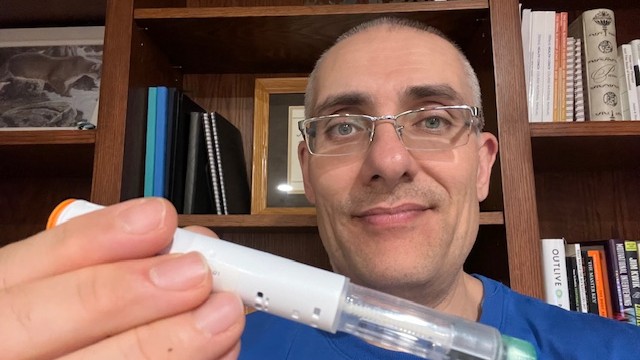
Pen injections are the clear winner and the only delivery method I use:
- Precise, controlled dosing with the highest bioavailability
- The peptide stays stable in storage
- Compliance becomes effortless once you get past the mental barrier of injecting
For high-performing entrepreneurs and executives who value outcomes over comfort, pens win every time.
What I Use And Why
I don’t recommend what I haven’t personally tested.
That’s why I decided to find a lab I could actually trust.
I have an extensive network of doctors, PhDs, longevity experts, and supplement entrepreneurs. I asked them all the same question: “Who’s doing this right? Who do you actually vouch for?”
Six labs made the first pass. Then I started asking the harder questions: Would they provide third-party analysis? What were their manufacturing ISO standards? Could they prove pharmaceutical-grade quality?
Two labs remained.
Then I vetted their testing protocols and quality standards in detail. Certificate of analysis. Purity standards. Manufacturing process transparency.
One lab stood out.
After months of research, I found what I’d been looking for: a verified lab with pharmaceutical-grade peptides delivered via preloaded pens. The needles are tiny and dosing is precise. The peptide stays stable in storage until you use it.
That’s when I came back to BPC-157 for maintenance and inflammation control.
It’s known for tissue repair, gut healing, and injury recovery. For me, it was about maintaining the gains I’d made from resolving my back injury and keeping inflammation low so I could train consistently without setbacks.
The change wasn’t overnight. But within weeks, my back stayed stable, recovery got faster, and I stopped having to constantly manage flare-ups just to maintain training consistency.
For leaders who refuse to stop performing but are tired of their body being the limiting factor, this is often the best entry point.
Later I added Tesamorelin for sleep quality and metabolic support. It’s often misunderstood and misused, but when it’s indicated and dosed properly, it’s powerful.
I’m having more deep sleep according to my wearable, my metabolic efficiency has improved, and my energy stays more consistent throughout the day. That matters when you’re stacking client calls, training sessions, team meetings, and still need to show up for your family at night without running on fumes.
These aren’t magic bullets. They’re strategic tools that support systems already under stress.
But they only work if the quality is there and the delivery method is solid.
Why Most Peptide Protocols Fail
If you’ve “tried peptides” and felt nothing, there’s a high chance the problem wasn’t the peptide. It was the product quality and delivery method. Get either one wrong and you’re wasting money.
Peptides are fragile. How they’re stored and delivered matters more than most people realize.
I see this constantly: A successful man running a company hears about peptides from a gym-bro influencer on a 90-second reel. Orders powder from an online pharmacy he’s never vetted. He reconstitutes it himself, stores it however he believes is correct, and injects whenever he remembers. Then wonders why his $400 experiment did nothing.
That’s like buying the cheapest protein powder you can find, taking it sporadically, and declaring that protein supplementation doesn’t work.
The problem isn’t the concept. It’s the execution.
Most leaders running companies would never greenlight a business deal without vetting the vendor, the product quality, and the delivery logistics. But with peptides? They treat it like a casual experiment with products they haven’t verified.
That’s not strategic. That’s reckless.
Why We Test First
Peptides amplify signals in your body. If you don’t know which signals are weak, overactive, or unnecessary, you’re guessing.
Testing tells us which systems are failing and which are fine, so you’re investing strategically instead of guessing.
That’s the difference between strategic optimization and expensive guesswork.
Successful business leaders run full due diligence before making a business investment. They stress-test, verify sources, and demand proof before committing capital.
Your body deserves the same approach.
If you’re curious about whether peptides make sense for your biology (not someone else’s protocol), or what to order from this vetted source, book a call with me https://calendly.com/info-20912/discovery-call-1.
I’m happy to walk through what matters and what’s just noise.
Cheers,
Deepak